Q1. TALON™ resin이 무엇인가요?
TALON™은 코발트 이온(Co2+)을 사용한 IMAC (Immobilized metal affinity chromatography) resin입니다. 코발트 이온을 이용한 TALON resin은 Nickel
(Ni2+) resin보다 더 높은 특이성으로 his-tag 단백질과 결합할 수 있어 고순도의 단백질을 정제할 수 있습니다.
Q2. 어떤 종류의 His-Tagged 단백질이 TALON™ resin에 결합할 수 있나요?
TALON™ resin은 6x His-, 6x HN-, HAT (histidine affinity tag)-tagged 단백질과 결합할 수 있습니다. 이러한 tag 서열을 목적단백질의 N-말단이나 C 말단 양단에
융합하여 정제할 수 있으며, histidine-rich 단백질과 같은 wild-type protein도 정제할 수 있습니다.
Q3. TALON™ resin이 Nickel resin(Ni-NTA)에 비해 고순도로 단백질이 정제 가능한 이유가 무엇인가요?
코발트이온이 결합되어있는 TALON 결합 코어 (TALON reactive core)는 니켈 이온보다 정확하게 histidine-tag과 결합합니다. TALON resin은 구조적으로 정확하게
위치한 histidine만을 결합하여 특이적으로 정제가 가능한 반면, Nickel resin은 histidine-tag에 대한 결합 조건이 비교적 까다롭지 않으므로 원치 않는 단백질
(contaminants)이 histidine 단백질과 함께 정제됩니다.
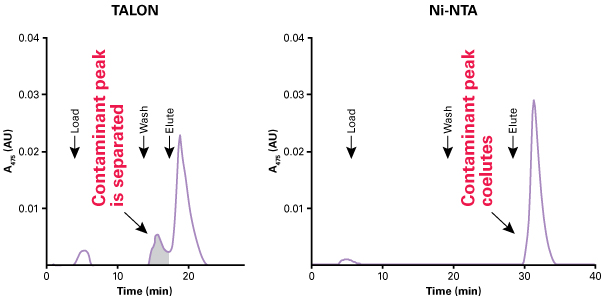 그림. IMAC purification?TALON vs. Ni-NTA.
 6xHN-AcGFP1 was purified from Sf21 cells using TALON or Ni-NTA. The chromatogram for each column is shown.
The absorbance at 475 nm indicates the amount of target protein (AcGFP1) in each fraction.
Q4. TALON™ resin을 사용해 정제한 단백질이 nickel resin을 사용했을 때 보다 높은 활성 (biological activity)을 유지하는 이유는 무엇인가요?
TALON resin은 니켈 기반의 resin에 비하여 보다 특이적으로 His-tag 단백질과 결합하기 때문에 washing, elution 버퍼의 조성 등의 정제 실험 조건이 physiological 환경에
더 유사하므로 단백질의 native folding과 높은 순도를 유지할 수 있기 때문입니다. 또한 TALON resin은 metal chelater site가 4개인 사중체 (tetradentate)이기 때문에
elution 과정에서 금속 이온의 용출이 거의 일어나지 않아 상대적으로 고순도의 생물학적 활성 (biological activity)을 가진 단백질을 정제 가능 합니다.
Q5. TALON™ resin의 정제량 (Binding capacity)은 어느 정도인가요?
TALON resin은 일반적으로 5 - 15 ㎎/㎖의 binding capacity를 가지며, 사용하는 histidine-tag의 크기나 형태에 따라 달라질 수 있습니다.
Q6. TALON™ resin 정제 능력은 온도에 영향을 받나요?
단백질의 변성 (denaturation)을 방지하기 위하여 저온의 환경이 요구되는 경우, 4℃ 에서 정제 과정을 진행하십시오. TALON resin의 결합 능력은 실온 또는 4℃ 환경에서
달라지지 않습니다. 하지만, TALON resin을 얼리는 것은 resin agarose beads가 깨져 금속이온의 용출과 결합능력의 실활을 야기할 수 있습니다.
Q7. HisTALON Gravity Column을 로딩할 수 있는 샘플의 양은 어느 정도인가요?
Q8. TALON™ column과 TALON™ Resin을 재사용 (Regeneration) 가능한가요?
예. TALON column은 MES/NaCl buffer를 이용하여 잔존하는 imidazole을 제거하면 재사용 (regeneration)이 가능 합니다만,
처음 사용한 resin과 동일한 binding capacity를 보장하지는 않습니다. 다카라는 단백질 정제 과정에서의 교차 오염을 방지하기 위하여 같은 단백질을 사용하는 경우에만 재사용 (resin regeneration) 하는 것을 권장합니다. 자세한 regeneration 프로토콜은
TALON Metal Affinity Resin User Manual을 참고 하십시오.
Q9. Resin을 더 이상 사용 또는 재사용할 수 없음을, 어떻게 확인 가능한가요?
TALON resin이 원래 색깔인 분홍색을 더 이상 띄지 않거나, 불투명한 흰색 혹은 갈색으로 색이 변한 경우, binding capacity가 현저히 저하된 경우
더 이상 사용이 불가능합니다. 이는 일반적으로 TALON resin과 대응이 되지 않는 버퍼를 이용한 경우 또는 재사용 (Regeneration)을 너무 많이 한 경우에 나타납니다.
이러한 경우 새로운 TALON Resin을 이용하십시오.
Q10. TALON™ resin에 적용할 수 있는 버퍼의 종류가 궁금합니다.
TALON Resin은 일반적으로 실험실에서 이용하는 대부분의 버퍼에 적용 가능합니다. 하지만 DTT (dithiothreitol), EDTA (ethylene diamine tetraacetic acid),
EGTA (ethylene glycol-bis(beta-amino-ethyl ether)), PEI (polyethyleneimine)은 TALON Resin에 적용이 불가합니다. 특히 DTT는 thiol-reducing complex를
생성하여 TALON resin을 불안정하게 만듭니다. 아래의 표를 참고 하십시오.
1) Reagents Compatible with TALON Resin
Reagent |
Acceptable Concentration |
Beta-mercaptoethanola |
10 mM (with caution) |
CHAPSb |
1% (with caution) |
Ethanolc |
30% |
Ethylene glycol |
30% |
HEPES |
50 mM |
Glycerol |
20% |
Guanidiniuma |
6 mM |
Imidazoled |
200 mM at pH 7.0?8.0, for elution |
KCl |
500 mM |
MES |
20 mM |
MOPS |
50 mM |
NaCl |
1.0 M |
NP-40 |
1% |
SDSb |
1% with caution |
TRISe |
50 mM |
Triton-X 100 |
<1% |
Urea |
8 M |
a Use resin immediately after equilibrating with buffers containing these reagents. Otherwise, the resin will change color.
Do not store resin in buffers containing these reagents.
b Ionic detergents like CHAPS (3-[(3-Cholamidopropyl)-dimethylammonio]-1-propane-sulfonate), SDS (sodium dodecyl sulfate), and sarkosyl are compatible up to 1%.
However, due to their charged nature, you should anticipate interference with binding.
c Ethanol may precipitate proteins, causing low yields and column clogging.
d Imidazole cannot be used at concentrations higher than 5-10 mM for loading his-tagged proteins, because it competes with the histidine side chains
(imidazole groups) for binding to the immobilized metal ions.
e TRIS coordinates weakly with metal ions, causing a decrease in capacity.
2) Reagents Incompatible with TALON Resin
These reagents are incompatible at any concentration:
- DTT (dithiothreitol) and DTE (dithioerythritol)
NOTE: Using strong reducing agents will interfere with cobalt metal ion binding to the resin.
- EDTA (ethylenediaminetetraacetic acid), EGTA (ethylene glycol-bis([β-amino-ethyl ether]), and PEI
NOTE: Although you can use EDTA at indicated points, it must be removed from the sample by gel filtration prior to applying the sample to TALON Resins.
Q11. TALON™ resin과 같은 IMAC resin에 사용할 수 있는 imidazole의 최대 농도는 얼마인가요?
사용할 수 있는 Imidazole의 최대 농도는 250 mM입니다. 250 mM보다 높은 농도의 Imidazole을 이용하는 경우 코발트 이온의 용출을 야기할 수 있습니다.
Q12. TALON™ resin에 적용할 수 있는 PMSF의 최대 농도는 얼마인가요?
Q13. TALON™ resin 사용에 추천하는 xTractor Buffer가 무엇인가요?
xTractor Buffer (Code 635656)는 박테리아,
효모, mammalian cell, baculovirus-infected cell 로부터 단백질 정제를 할 경우 사용 가능한 효율적인 Lysis buffer 입니다. 본 제품을 사용하면 non-denaturing 조건 하에서
10분 안에 빠르고 효율적으로 lysis 과정을 진행할 수 있으며, IMAC resin을 이용한 단백질 정제에 최적화 되어있습니다.
Q14. Mammalian cell에 xTractor Buffer를 적용할 경우 lysozyme을 처리해야 하나요?
xTractor Buffer (Code 635656)는
박테리아, 효모, mammalian cell, baculovirus-infected cell 로부터 단백질 정제를 할 경우 사용 가능한 효율적인 Lysis buffer 입니다. 본 제품을 사용하면 non-denaturing
조건 하에서 10분 안에 빠르고 효율적으로 lysis 과정을 진행할 수 있으며, IMAC resin을 이용한 단백질 정제에 최적화 되어있습니다.
Q15. xTractor Buffer의 조성이 어떻게 되나요?
xTractor Buffer의 조성은 공개 불가합니다. xTractor Buffer는 chelating agent나 protease inhibitor를 포함하고 있지 않으며, his-tagged protein을 정제하기
위한 spin column이나 TALON Resin에 최적화 되어있습니다.
Q16. xTractor Buffer로 추출할 수 있는 단백질 종류가 궁금합니다.
다카라는 다양한
E.coli strain에서 xTractor Buffer로 아래의 단백질을 추출한 바 있습니다.
- 6x(HN)-LacZ (beta-galactosidase)
- 6x(His)-LacZ
- 6x(HN)-GFPuv (Green Fluorescent Protein)
- 6x(His)-GFPuv
- HAT-DHFR (DiHydro Folate Reductase)
- 6x(HN)-Luciferase