(1) ChIP Elute Kit 가 무엇인가요? 왜 사용해야 하나요?
What is the ChIP Elute Kit? Why would I want to use it?
The
ChIP Elute Kit allows for DNA elution from Protein A/G agarose or magnetic beads and cross-linking reversal in a single step. This kit is significantly faster and more convenient than traditional methods. The ChIP Elute Kit takes only one hour (including DNA purification), while traditional methods make take up to overnight. Since single-stranded DNA (ssDNA) is produced using the ChIP Elute method, this method is appropriate for ChIP experiments that are followed by qPCR, or ChIP-seq experiments if using a DNA SMART ChIP-Seq Kit (which are fully compatible with ssDNA inputs). Using the ChIP Elute method in combination with the DNA SMART ChIP-Seq Kit makes ChIP-seq less tedious and time-consuming.
Are ChIP-seq results the same whether I use the standard method or the ChIP Elute Kit?
Yes. Sequencing libraries generated from DNA eluted with either the
ChIP Elute Kit or traditional methods show comparable sequencing metrics.
Should I clean up my ChIP DNA prior to library preparation?
Yes. The
ChIP Elute Kit includes column-based DNA purification and concentration. ChIP DNA prepared using this kit is directly compatible with the DNA SMART ChIP-Seq Kit without further purification.
- If you use another method for cross-linking reversal and DNA elution, we recommend the NucleoSpin Gel and PCR Clean-Up kit along with Buffer NTB (available separately; Cat. # 740595.150), which is specially formulated to accommodate samples with high SDS concentrations.
Note: If your DNA is single-stranded, you will need to use Buffer NTC (Cat. # 740654.100) with the NucleoSpin Gel and PCR Clean-Up kit.
I am using ChIP to look at histone modifications with only 10,000 cells. Will the ChIP Elute and DNA SMART ChIP-Seq kits work with such a small input?
Yes. We have analyzed DNA from H3K4me3 pull-downs using 10,000-1 million cells, using the
ChIP Elute Kit at the end of our ChIP workflow followed by a
DNA SMART ChIP-Seq Kit. We obtained a reasonable yield from 10,000 cells using 18 PCR cycles.
Do I need to treat my samples with RNase prior to library preparation?
No. Residual RNases in the sample may compromise the success of library preparation. Furthermore, the terminal deoxynucleotidyl transferase will not use RNA as a template in the T-tailing step, and the use of a poly(dA) primer, instead of a poly(dT) primer, makes priming to RNA unlikely.
(6) DNA SMART ChIP-Seq에 적용할 수 있는 ChIP DNA의 길이는 어떻게 되나요?
What size fragments can the DNA SMART ChIP-Seq Kit accommodate?
DNA fragments longer than 100 bp can be used with the
DNA SMART ChIP-Seq Kit. If desired, fragments several kb in length can easily be amplified; however, this kit has been tested specifically with ChIP DNA fragments ranging from 100 to 500 bp (with an average of 200-400 bp). The PCR cycling guidelines in the DNA SMART ChIP-Seq User Manual are based on DNA fragments in this range. If your DNA is substantially longer or shorter, the optimal number of PCR cycles will need to be determined empirically.
Why are size selection and cleanup not performed before the PCR step as in other kits?
In ligation-based kits, a pre-PCR cleanup step is required to remove adapter dimers. The DNA
SMART ChIP-Seq Kit does not use ligation, and high-quality ChIP-seq libraries can be obtained without size selection. However, specific applications such as identification of transcription factor binding sites may benefit from stringent size selection. We have found that pre-PCR size selection reduces the complexity of the final library, with increased PCR duplicates (see our tech note for more information). Our single-tube workflow allows for size selection and cleanup following the PCR step, and our protocol provides guidance for more or less stringent size selection. We have found that the basic protocol (Option 1) removes larger PCR fragments (that do not cluster well) without compromising library complexity.
How much sequence is added to my samples in the final library?
Together, the DNA SMART Oligo, DNA SMART Poly(dA) Primer, and the Indexing Primers for Illumina add 153 bp to the initial DNA fragment length.
(9) Library를 전기영동 했을 때, agarose gel에서 아무 것도 보이지 않는 이유는 무엇인가요?
Why don’t I see anything when I run the libraries on an agarose gel?
We do not recommend running the final libraries on an agarose gel. To minimize biases, ChIP-seq libraries (as well as other types of next-generation sequencing libraries) should not be overamplified. The low concentration of the final library makes visualization on agarose gels very difficult. Instead, we recommend quantifying the libraries with a Qubit 2.0 Fluorometer (Thermo Fisher Scientific) with the Qubit dsDNA HS Assay Kit (Thermo Fisher Scientific, Cat. # Q32851 and Q32854). To evaluate library quality, run 1 ㎕ of the library on an Agilent 2100 Bioanalyzer using the High Sensitivity DNA Kit (Agilent, Cat. # 5067-4626).
Note: For optimal resolution, if the library concentration is >2 ng/㎕, dilute the library in water or Library Elution Buffer to a concentration of 1-2 ng/㎕ prior to running on the Agilent Bioanalyzer.
(10) Library yield는 어느 정도 인가요?
What library yield should I expect?
Our guidelines typically result in a final library yield of >5 ng/㎕ (>20-25 nM). Lower yield (2-3 ng/㎕) may be typical for very low inputs (100 pg), but is still enough for sequencing. If you obtain >25 ng/㎕, consider reducing the number of cycles to minimize potential biases.
(11) 제작된 ChIP-Seq library 내에 index는 어디에 위치하나요?
Where are the indexes in the final ChIP-seq libraries?
Indexed adapters for Illumina sequencing are present in the PCR primers used to amplify the ChIP-seq library. The Index 1 (i7) sequence is found on the Reverse PCR Primer HT while the Index 2 (i5) sequence is found on the Forward PCR Primer HT. When selecting settings for sequencing, HT indexes should be used. The specific sequence of the indexes on these primers is the same as the standard Illumina HT indexes, and can also be found in the
DNA SMART ChIP-Seq Kit User Manual.
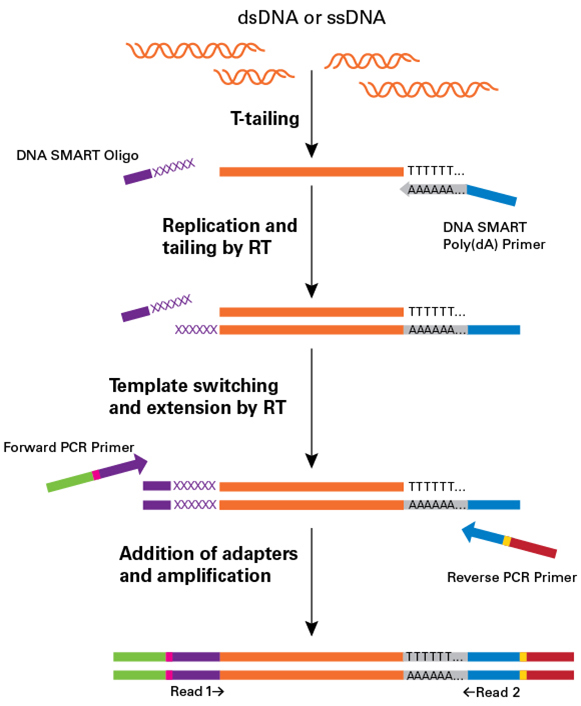 Overview of template switching in the DNA SMART ChIP-Seq Kit.
The Index 1 (i7) sequence (indicated in yellow) is found on the Reverse PCR Primer HT while the Index 2 (i5) sequence (indicated in pink) is found on the Forward PCR Primer HT.
Which indexes are included in the DNA SMART ChIP-Seq kits?
There are three versions of the
DNA SMART ChIP-Seq Kit. They all contain PCR primers with indexes identical to those in the Illumina TruSeq DNA HT Sample Prep Kit. Forward PCR Primers contain the i5 index, and Reverse PCR Primers contain the i7 index.
Together, the DNA SMART ChIP-Seq Kit - 48 A and the DNA SMART ChIP-Seq Kit - 48 B can be used to generate libraries incorporating all 96 high-throughput Illumina indexes. The nucleotide sequences for the indexes can be found in the DNA SMART ChIP-Seq Kit User Manual.
How many samples can I multiplex per run?
ChIP-seq libraries generated with the
DNA SMART ChIP-Seq Kit contain adapters and indexes for Illumina sequencing. There are three versions of this kit that allow production of either 12 or 48 indexed libraries. It is also possible to use both versions of the 48-reaction kit (the DNA SMART ChIP-Seq Kit - 48 A and B) to generate the full 96 high-throughput Illumina indexes. Not all indexes can be pooled together; consult the Illumina literature (such as the "TruSeq
® DNA Sample Preparation Guide") for appropriate pooling guidelines. If needed, compare the index sequences in the DNA SMART ChIP-Seq Kit User Manual with Illumina adapter sequences.
Can I do paired-end sequencing with the DNA SMART ChIP-Seq Kit?
Single-end sequencing with Read 1 is generally sufficient for ChIP-seq. However, if paired-end sequencing is desired, you should use the DNA SMART Custom Read2 Seq Primer provided in the kit (if your sequencing facility accepts custom primers). The custom primer can be used on an Illumina MiSeq® instrument or sent along with your samples to your sequencing facility for a HiSeq® run.
(15) Mapping 전에 trimming해야 하나요?
Do I need to trim my reads before mapping?
You should trim three nucleotides from the 5' end of your reads (Read 1). Optionally, you may also trim Illumina adapter sequences and stretches of poly(T), particularly if you read more than 50 nucleotides, as sequences from short inserts will contain the T-tail that is added in the library construction process.
(16) 3’ 말단의 긴 poly(T) 서열들은 무엇을 의미하나요?
Some of my sequences (Read 1) have a poly(T) stretch at their 3' ends: what does this mean?
The lower limit of the AMPure bead size selection is not a perfect cutoff; a small proportion of the PCR products in the final library may have short inserts. In these cases, the sequencing from Read 1 will read through the T-tail added during library synthesis.